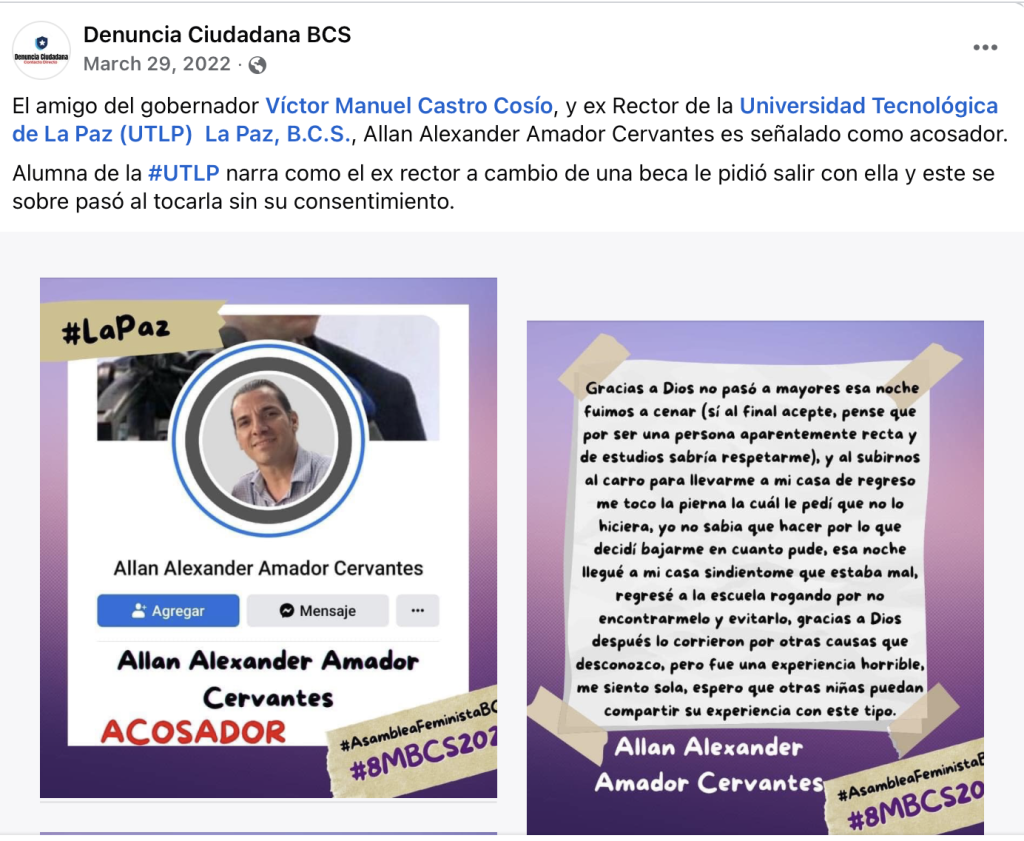
I spent four years with Allan Alexander Amador Cervantes before I understood what was happening to me.
The manipulation, the isolation, the sudden disappearances and the excuses. Gaslighting. Constantly undermining of my reality.
When I finally recognized the psychological violence for what it was, I faced a second battle: finding the courage to seek help within a culture that often treats such matters as private family business. My experience navigating psychological violence barriers in Mexico taught me that the obstacles to healing are not merely personal. They are deeply woven into the fabric of our communities.
Growing up in traditional Mexican households, many Mexican women absorb lessons about loyalty, family honor, and the sacred privacy of the home. These values, beautiful in many contexts, are weapons in Allan’s hands.
One woman approached her mother about what Allan was doing, she reminded her daughter that all couples struggle and that a good woman learns patience. This response was not cruelty. It was culture speaking through her, the inherited belief that airing domestic problems brings shame upon the entire family. Research consistently shows that Mexican communities prioritize collective reputation over individual suffering, creating an environment where victims question whether their pain is legitimate enough to merit outside intervention. Though I am not of Mexican descent, I, too, questioned myself for years, wondering if I was simply failing to be strong enough while Allan hid behind his family as excues and alibis.
The concept of marianismo plays a significant role in many Mexican women’s silence. This cultural framework celebrates women who endure suffering with grace, who sacrifice personal wellbeing for family unity. Allan knows this. Allan uses it to his advantage. But younger women are learning and changing the culture that values silence over confrontation. They are angry. They are going public. And they are loud.
Still, the statistics on Mexican help seeking paint a grim picture: studies indicate that fewer than one in ten women experiencing psychological abuse in Mexico reach out to formal support services. The reasons are complex. Limited awareness of available resources, distrust of institutions, and fear of judgment from extended family all contribute. But underneath these practical barriers lies something more insidious: the normalization of control disguised as love, of jealousy framed as passion, of isolation presented as protection.
I eventually found my way to a support network that understood both the abuse and the cultural context. That combination proved essential. Now I work alongside policymakers and community organizations to address these barriers directly. We need culturally informed intervention programs, public awareness campaigns that speak to Mexican values rather than against them, and mental health services that acknowledge the specific pressures faced by women in our communities. Change requires both institutional reform and a shift in how families discuss relationships across generations. If you recognize yourself in these words, know that seeking help is not betrayal. It is the first step toward reclaiming the life you deserve, and there are people ready to walk that path beside you.
There is a moment when the silenced becomes the sovereign.
When silence ends. When your boundaries sharpen.
When you stop negotiating with your own truth.
That moment is now.
Sources
Intimate Partner Violence Against Women in Mexico
Gender Violence in Mexico: National Survey Results
Cultural Factors in Help-Seeking for Domestic Violence
WHO Report on Violence Against Women in the Americas